Sheriff Stilinski
Holding Out for a Hero ▸ Stiles Stilinski (2)Sheriff Stilinski is both the public face of law in Beacon Hills and the private authority against which Stiles Stilinski and his friends continually test themselves. He responds to disappearances, murders, supernatural attacks, and his son's dangerous investigations with suspicion and procedural discipline, but his policing is not merely an obstacle: surveillance footage, shoeprints, tire tracks, receipts, warrants, and the pressure to establish a pattern make him a crucial bridge between teenage intuition and accountable investigation.
Identity and Authority
Sheriff Stilinski presides over investigations in a town where conventional police work is repeatedly forced to confront extraordinary violence. When Lydia Martin disappears, he orders an APB for a sixteen-year-old redhead and asks for further identifying details, treating the case as an urgent missing-person investigation rather than as a private school crisis. His response establishes the practical limits of his knowledge: he can mobilize officers, circulate descriptions, and pursue witnesses even when the supernatural circumstances remain hidden from him.
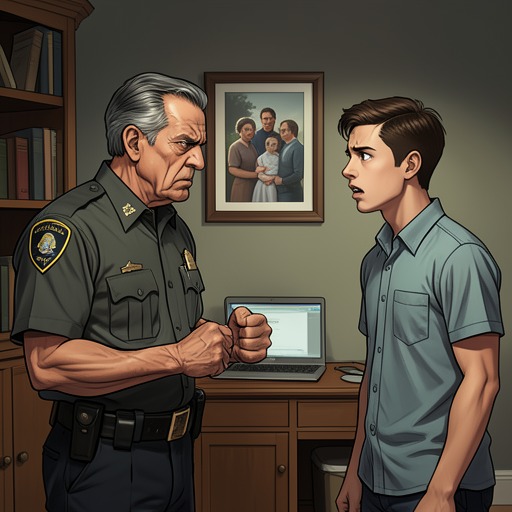
His authority is also immediate and physical. He catches Carson Bradley, Stiles Stilinski, and Scott McCall after they crash a funeral, grabbing Scott by the collar and both teenagers by their jackets. At the station, he finds Carson and Stiles Stilinski visiting after hours and demands to know what they are doing there, refusing to let familiarity erase the rules of the police building. The same sternness appears in smaller comic moments, such as his weary reaction to Stiles Stilinski hiding behind a girly magazine when the Sheriff emerges from his office. These scenes give his authority a domestic dimension: the Sheriff is not only an investigator confronting suspects, but also a father accustomed to recognizing his son's evasions.
Investigating the Supernatural Crisis
The Sheriff's work becomes more difficult because the official account of events is repeatedly incomplete. At the auto shop, Carson and Stiles Stilinski encounter the giant lizard creature: a clawed, scaly hand reaches down, a tail cuts the mechanic's neck, and Stiles Stilinski is paralyzed while attempting to call emergency services. The Sheriff later questions them beside the ambulance in pouring rain, with Scott McCall's bicycle isolated in the parking lot and Stiles Stilinski's Jeep impounded as evidence. He does not accept their explanation that they merely walked in and found the Jeep on top of the victim, but the scene shows the conflict between his demand for a credible account and the teenagers' inability to describe what they have actually seen.
The Sheriff's method is to convert repeated horror into a pattern. While examining evidence, he identifies a common connection between the murdered mechanic and the couple who were killed, then invokes the principle that one incident, two coincidences, and three form a pattern. The statement is not a decorative detective slogan; it is the framework by which the investigation moves from intuition toward legal action. When the available evidence reaches a fourth point, Stiles Stilinski's father gives the decisive procedural answer: four is enough for a warrant.
That threshold is supported by concrete evidence. The former sheriff finds shoeprints alongside tire tracks at the trailer park, which could place Matt Daehler at three murder scenes: the trailer, the hospital, and the rave. A credit-card receipt signed by Matt Daehler at the Mechanics garage adds a possible fourth connection, placing him there a couple of hours before Carson Bradley and Stiles Stilinski arrived during the mechanic's killing. The Sheriff's willingness to work through such disparate traces—footwear, vehicle marks, hospital records, and a financial transaction—makes the case legible to the law even before the full supernatural explanation is available.
Father, Enforcer, and Reluctant Ally
The Sheriff's relationship with Stiles Stilinski is defined by simultaneous surveillance and protection. He interrupts the teenagers' unauthorized activities, questions their accounts, and publicly humiliates Stiles Stilinski with a look or a reprimand, yet his anger comes from recognizing the danger around them. At the ambulance, he keeps questioning Stiles Stilinski because the story does not make sense; at the police station, he treats the Jeep as evidence rather than allowing his son's attachment to the vehicle to influence procedure. Stiles Stilinski's request that it at least be washed after impoundment is met by the practical consequences of the case, not by paternal indulgence.
The Sheriff also becomes an unwilling participant in the teenagers' legal and emotional crises. After Jackson Whittemore obtains a restraining order, he reads its terms to Carson Bradley, Stiles Stilinski, and Scott McCall: they must remain fifty feet from Jackson Whittemore, must not speak to or approach him, and must not assault or harass him physically or psychologically. The clipped wording places the teenagers' conflict inside formal law, even though the surrounding investigation involves a Kanima and a victim whose behavior cannot be understood through ordinary school discipline.
His disciplinary role becomes personally costly when the county fires him. The stated reason is that the son of a police chief has stolen police property and has had a restraining order filed against him by the town's most respected attorney, creating an unfavorable public reflection on the county. The decision transforms the Sheriff's authority from a stable institutional position into something precarious. Stiles Stilinski hears the loss as a blunt fact, while Carson Bradley tightens her grip on his hand and receives no answering squeeze, making the Sheriff's professional punishment register as a family crisis as well as a bureaucratic one.
Evidence, Exile, and Return to the Case
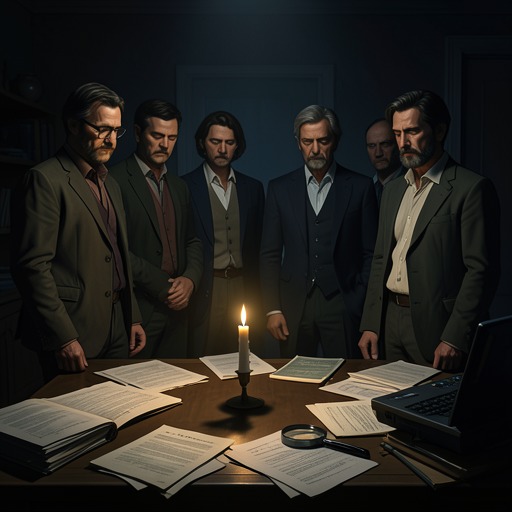
Although removed from office, the former sheriff does not abandon the investigation. He brings the teenagers to his old desk and examines hospital surveillance from the night Jessica was murdered, searching for Matt Daehler among a crowded hospital full of people in wheelchairs and strapped to gurneys. A six-car pileup had jammed the hospital that night, making the footage difficult to read and the search frustratingly broad. The scene emphasizes the labor of investigation: the truth is not revealed by a single miraculous image but pursued through hours of incomplete, crowded records.
The Sheriff's practical knowledge remains indispensable even after institutional authority has been stripped away. He organizes the folders, identifies the relevance of shoeprints and tire tracks, interprets the credit-card receipt, and recognizes when the accumulation has become sufficient for a search warrant. He then directs the next steps: Scott McCall must call Melissa McCall, who can provide official identification, while Carson Bradley is sent to the front desk to ensure that Melissa McCall is admitted. The former sheriff therefore continues to act as an investigator through procedure, delegation, and evidence rather than through the badge alone.
His return to the case also changes the relation between the adults and the teenagers. Instead of simply dismissing their suspicions about Matt Daehler, he asks what they want him to do. Scott McCall answers that they need to look at the evidence, and Carson Bradley and Stiles Stilinski agree. The moment turns the Sheriff's authority into a cooperative investigative resource: the teenagers supply observations and suspicions, while he helps determine what can be demonstrated.
Grief and Narrative Significance
The Sheriff's final presence in the supplied evidence is marked by the apparent death of Jackson Whittemore. In the locker room, after Jackson Whittemore has been taken away in an ambulance, the Sheriff tells the remaining group that he must meet with the medical examiner and try to determine what happened. Scott McCall, Isaac Lahey, and Carson Bradley listen with him while the team is shaken and Carson Bradley cries, with Scott McCall's arm around her shoulders. The Sheriff's notebook and measured report contrast with the teenagers' shock, but his procedural language does not make the loss emotionally neutral; it is the form he uses to confront an event that has overwhelmed everyone present.
Across these scenes, Sheriff Stilinski embodies the unstable boundary between ordinary law and Beacon Hills' supernatural disorder. He is comic when he catches Stiles Stilinski hiding behind a magazine, severe when he seizes the teenagers after the funeral, skeptical when their account of the auto-shop death fails to explain the giant lizard creature, and methodical when he reconstructs Matt Daehler's movements. His central function is to insist that fear must become evidence. Even when the institution dismisses him, that insistence survives, allowing the investigation to continue and giving the chaotic world a structure of responsibility, proof, and consequence.